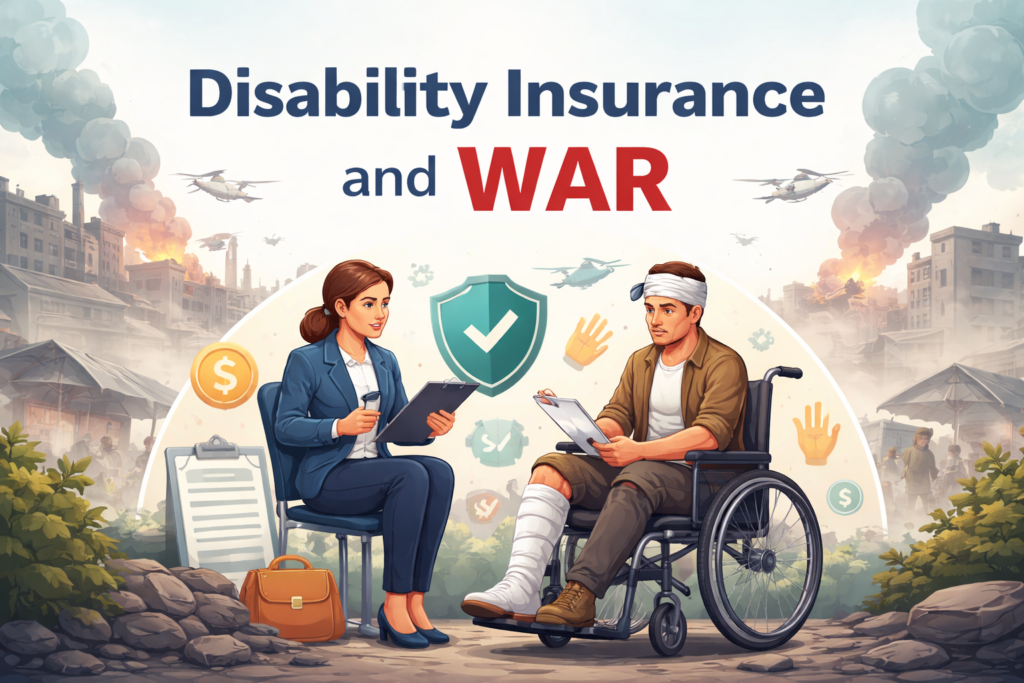
Disability Insurance During War Living or working in a region affected by conflict brings a level of uncertainty that most standard financial plans are not designed to handle. One of the biggest concerns people often overlook is the risk of losing their ability to earn income due to injury or disability caused by war-related events.
Disability insurance becomes especially important in these situations. It is designed to replace a portion of your income if you are unable to work due to illness or injury. However, during wartime, the rules around coverage can become more complicated. Many policies include specific clauses that limit or exclude claims linked to war, terrorism, or civil unrest.
This means that relying on a standard disability insurance plan without reviewing its terms could leave you financially vulnerable at the worst possible time. Whether you are a civilian living in a conflict zone, a contractor working abroad, or someone concerned about global instability, understanding how disability insurance works during war is critical.
In this guide, you will learn how disability insurance policies respond to wartime risks, what limitations to watch for, and how to make smarter decisions to protect your income even in high-risk environments.
Table of Contents
What Is Disability Insurance?
Disability insurance is a type of financial protection that replaces a portion of your income if you become unable to work due to injury or illness. Instead of facing a complete loss of earnings, this coverage helps you continue paying for essential expenses like rent, food, medical bills, and daily living costs.
At its core, disability insurance acts as an income safety net. If something unexpected happens and you can’t perform your job, the policy provides regular payments, usually on a monthly basis, until you recover or reach the end of the coverage period.
There are two main types of disability insurance:
1. Short-Term Disability Insurance
This type provides coverage for a limited period, typically from a few weeks up to 6 months. It is designed for temporary injuries or illnesses that prevent you from working for a short time. For example, if someone is injured in a non-combat-related accident during unstable conditions, short-term disability may help cover immediate financial needs.
2. Long-Term Disability Insurance
Long-term disability insurance offers extended coverage, sometimes lasting several years or even until retirement age. It is more relevant in serious situations where a person suffers permanent or long-lasting disability. In war-affected regions, this type of policy becomes especially important due to the higher risk of severe injuries.
How Payments Work
Most disability insurance policies replace around 50% to 70% of your income. The exact amount depends on your policy terms. There is also usually a waiting period (called an elimination period) before payments begin, which can range from a few days to several months.
Own Occupation vs Any Occupation
Another important concept is how the policy defines disability:
- Own Occupation: You receive benefits if you can’t perform your specific job.
- Any Occupation: You only receive benefits if you can’t perform any job at all.
In high-risk environments, “own occupation” coverage is generally more protective because it provides benefits even if you can work in a different, lower-paying job.
Why It Matters During War
In conflict situations, the chances of injury increase significantly, not just from direct combat but also from indirect risks like infrastructure damage, limited medical access, or accidents during evacuations. Disability insurance ensures that even if your ability to work is affected, you still have a financial lifeline.
However, the real challenge lies in understanding what your policy actually covers during wartime, which we’ll explore in the next section.
How War Impacts Disability Risks
War dramatically increases the risk of injury and long-term disability, even for people who are not directly involved in combat. In fact, many disabilities during conflict situations happen due to indirect causes rather than frontline fighting.
1. Increased Physical Danger
During war, everyday environments become unpredictable. Roads, workplaces, and public areas may no longer be safe. Risks include:
- Explosions and airstrikes
- Collapsing buildings and infrastructure damage
- Gunfire or nearby combat situations
- Landmines or unexploded ordnance
Even routine activities like commuting or working can suddenly turn dangerous, raising the likelihood of serious injuries that can lead to permanent disability.
2. Limited Access to Healthcare
Healthcare systems often become overwhelmed or damaged during war. Hospitals may be understaffed, under-equipped, or completely destroyed. This leads to:
- Delayed medical treatment
- Poor rehabilitation services
- Higher chances of complications
An injury that might have been treatable in normal conditions can become life-altering simply due to lack of proper care.
3. Psychological and Mental Health Impact
War doesn’t just affect the body, it also impacts mental health. Conditions such as:
- Post-traumatic stress
- Severe anxiety
- Depression
can become disabling over time. In many cases, these conditions prevent individuals from continuing their work, especially in high-pressure or skilled professions.
4. Displacement and Unsafe Living Conditions
Many people are forced to leave their homes during conflict. Displacement increases exposure to:
- Poor living conditions
- Lack of sanitation
- Malnutrition
- Increased risk of disease
These factors can contribute to both physical and long-term health problems, increasing the likelihood of disability.
5. Workplace Hazards Increase
In war-affected areas, people often continue working in unsafe environments due to necessity. For example:
- Construction without safety regulations
- Transporting goods through dangerous zones
- Working in damaged factories or buildings
This significantly raises the risk of accidents and injuries that could lead to temporary or permanent disability.
Why This Matters for Insurance
All these factors combined make disability much more likely during wartime. However, insurance companies also recognize this increased risk, which is why many policies include strict conditions, exclusions, or limitations related to war.
Understanding these risks helps you see why simply having disability insurance is not enough, you must know exactly what situations are covered.
Does Disability Insurance Cover War-Related Injuries?
This is the most critical part of the topic, because having disability insurance does not automatically mean you are protected during war.
In reality, many standard disability insurance policies have strict rules when it comes to war-related injuries.
1. War Exclusion Clause (Most Important)
Most insurance policies include something called a war exclusion clause. This means:
- Injuries caused directly by war are often not covered
- This includes declared wars, undeclared conflicts, civil wars, and sometimes even terrorism
For example, if someone is injured due to a bombing or military action, the insurer may deny the claim based on this clause.
2. Direct vs Indirect Injuries
Some policies make a distinction between direct and indirect causes:
- Direct war injuries (explosions, gunfire, combat) → usually excluded
- Indirect injuries (accidents during evacuation, illness due to poor conditions) → may be covered
This depends heavily on how the policy is written. The wording can make a big difference in whether a claim is accepted or rejected.
3. Civilian vs Military Coverage
- Military personnel are usually covered under separate government or military insurance programs
- Civilians rely on private insurance, which often has more restrictions
If you are a civilian contractor, journalist, or aid worker in a conflict zone, your standard policy may not fully protect you.
4. Special War-Risk Policies
Some insurers offer war-risk disability insurance as an add-on or separate policy. These plans:
- Provide coverage specifically for war-related injuries
- Are commonly used by journalists, NGOs, and international workers
- Usually come with higher premiums due to increased risk
If you are living or working in a high-risk region, this type of coverage can be essential.
5. Government and Employer Support
In some cases:
- Governments may offer compensation programs for war victims
- Employers (especially international organizations) may provide specialized insurance
However, these benefits are not always guaranteed and may not fully replace your income.
6. Why You Must Read the Fine Print
Two policies may look similar but have completely different outcomes during war. Key things to check:
- Is war explicitly excluded?
- Are there exceptions for civilians?
- Does the policy cover terrorism or civil unrest?
- Are indirect injuries included?
A small clause can determine whether you receive financial support or nothing at all.
Bottom Line
Standard disability insurance often does not fully cover war-related risks. To truly protect yourself, you need to:
- Understand your policy in detail
- Look for gaps in coverage
- Consider specialized war-risk insurance if needed
Types of Disability Insurance Policies
Not all disability insurance policies are the same, and this becomes even more important during wartime. The type of policy you choose can determine how much protection you actually have when risks are higher.
Here are the main types you should understand:
1. Individual Disability Insurance
This is a policy you purchase on your own from an insurance company.
Key features:
- Fully customizable coverage
- Portable (you keep it even if you change jobs)
- Stronger control over policy terms
During war:
Individual policies often have clear exclusions for war, but they may also offer optional riders or add-ons for high-risk situations. These are generally more reliable than basic group plans because you know exactly what you’re getting.
2. Group Disability Insurance (Employer-Provided)
This coverage is provided by your employer, often as part of a benefits package.
Key features:
- Lower cost or sometimes free
- Basic coverage for employees
- Limited flexibility
During war:
Group policies are usually more restrictive. They often include strict war exclusion clauses and may not cover employees working in high-risk regions. If your job sends you into a conflict zone, relying only on this type of policy can be risky.
3. Short-Term vs Long-Term Disability Policies
While we discussed these earlier, it’s important to compare them in a wartime context:
- Short-Term Policies:
Help with immediate income loss but only for a limited time - Long-Term Policies:
Provide extended financial protection, which is crucial if injuries are severe or permanent
During war:
Long-term coverage becomes far more valuable due to the higher chance of serious, life-changing injuries.
4. High-Risk or Specialty Disability Insurance
These are designed for people working in dangerous environments, such as:
- War correspondents
- Security contractors
- Humanitarian workers
Key features:
- May include coverage for war-related injuries
- Tailored for specific high-risk professions
- Higher premiums
During war:
This is often the most relevant option if you are directly exposed to conflict. It fills the gaps left by standard policies.
5. Government or Social Disability Programs
Some countries provide disability benefits through government programs.
Key features:
- Basic financial support
- Eligibility based on national rules
- Limited payouts compared to private insurance
During war:
These programs may become strained or harder to access. In some cases, they may expand support, but relying solely on them is uncertain.
6. Riders and Add-Ons
A rider is an extra feature you can add to your policy for more protection.
Common examples:
- Cost-of-living adjustment (COLA)
- Residual or partial disability coverage
- Catastrophic disability benefit
During war:
Some insurers offer war-risk riders, though they are not always available. If offered, they can significantly improve your coverage.
Which Type Is Best in War Conditions?
There is no one-size-fits-all answer, but generally:
- Individual policies + war-risk add-ons = strongest protection
- Group insurance alone = not enough in high-risk zones
- Specialty insurance = best for high-exposure professions
Key Takeaway
The type of disability insurance you have matters just as much as having insurance at all. In wartime, basic coverage is often not enough, and choosing the right policy structure can make a huge difference in your financial security.
Key Exclusions to Watch During War
Even the best disability insurance policy can fail you if you don’t understand its exclusions. During wartime, these exclusions become especially important because they often determine whether your claim will be approved or denied.
Here are the most critical exclusions you need to watch closely:
1. War and Armed Conflict Exclusion
This is the most common and most important exclusion.
It typically means:
- No coverage for injuries caused by war
- Applies to declared and undeclared wars
- May include civil war, rebellion, or military actions
Some policies go even further and include terrorism or insurgency under this exclusion.
Why it matters:
This single clause can completely void your coverage in a conflict zone.
2. Terrorism and Civil Unrest
Not all policies treat these the same way.
- Some policies exclude terrorism entirely
- Others may cover it under certain conditions
- Civil unrest (riots, protests) may or may not be included
Example:
If you are injured during a violent protest or bombing, your claim outcome depends on how your policy defines these events.
3. Intentional Risk or Hazardous Activities
If you knowingly place yourself in danger, your claim could be denied.
This may include:
- Traveling to high-risk or restricted areas
- Working in conflict zones without proper coverage
- Ignoring government travel warnings
Why it matters:
Insurers may argue that you accepted the risk, especially during wartime.
4. Military Service Exclusion
Most standard disability policies do not cover:
- Active military personnel
- Injuries sustained during military duties
These individuals usually rely on government or military-specific insurance programs instead.
5. Pre-Existing Conditions
If you already have a medical condition before getting insured:
- It may not be covered
- It may have a waiting period before coverage begins
During war:
Existing injuries or mental health conditions can worsen, but your policy might not cover them if they were already present.
6. Mental Health Limitations
Some policies limit coverage for mental health conditions such as:
- Post-traumatic stress
- Anxiety disorders
- Depression
They may:
- Cap the benefit period (e.g., only 1–2 years)
- Require strict medical proof
Why it matters:
Mental health issues are very common in war environments, yet often under-covered.
7. Geographic Restrictions
Certain policies limit where coverage applies.
- Coverage may not apply in specific countries or regions
- High-risk zones may be excluded entirely
Example:
If you move or travel to a conflict area, your policy might stop covering you without clear notice.
How to Protect Yourself
Before relying on your policy, take these steps:
- Carefully read all exclusion clauses
- Ask your insurer directly about war-related scenarios
- Get written confirmation of coverage
- Consider upgrading or adding specialized coverage if needed
Key Takeaway
Exclusions are where most people get caught off guard. During war, these clauses are often the reason claims are denied. Understanding them in advance can save you from serious financial loss.
How to Choose the Right Policy in High-Risk Areas
Choosing disability insurance during stable times is already important, but in high-risk or conflict-affected areas, it requires much more careful attention. The wrong policy can leave you completely unprotected when you need it most.
Here’s how to make a smarter and safer choice:
1. Look Beyond Basic Coverage
A standard policy may seem sufficient, but in high-risk areas, basic coverage often has limitations.
What to check:
- Does it include or exclude war-related injuries?
- Are indirect risks (accidents, illness during conflict) covered?
- Are there any hidden restrictions?
Tip: Never assume coverage. Always verify.
2. Prioritize Policies with Flexible Definitions
The way a policy defines “disability” matters a lot.
- Own occupation policies are more protective
- Any occupation policies are stricter and harder to claim
In high-risk areas:
An own occupation policy gives you better financial security, especially if you cannot return to your specific profession after an injury.
3. Check Geographic Coverage
Make sure your policy is valid where you live or plan to travel.
Ask:
- Is coverage valid internationally?
- Are conflict zones excluded?
- Will coverage continue if conditions worsen?
Tip: Get written confirmation if you are in or near a high-risk region.
4. Consider War-Risk Add-Ons or Specialized Policies
If you are exposed to conflict, this is one of the most important steps.
Options include:
- War-risk riders added to your policy
- Specialized high-risk insurance plans
Who needs this most:
- Journalists
- Contractors
- Aid workers
- Frequent travelers to unstable regions
5. Evaluate the Insurer’s Reputation
Not all insurance companies handle claims the same way.
Look for:
- Strong claim approval history
- Clear policy wording
- Good customer support
Tip: A cheaper policy is not always better if it becomes difficult to claim during a crisis.
6. Understand Waiting Periods and Benefit Duration
Key factors:
- Elimination period (how long before payments start)
- Benefit period (how long payments continue)
In wartime:
Shorter waiting periods and longer benefit durations provide stronger protection, especially when recovery may take longer.
7. Balance Cost vs Coverage
Higher-risk coverage usually means higher premiums.
Instead of choosing the cheapest option:
- Focus on what risks are actually covered
- Identify critical gaps
- Invest in protection that matches your situation
8. Get Professional Advice
If your situation is complex, consider speaking with:
- Insurance advisors
- Financial planners
- Specialists in high-risk coverage
They can help you understand fine print and recommend suitable options.
Key Takeaway
In high-risk or war-affected areas, choosing disability insurance is not just about having a policy, it’s about having the right policy. Careful review, the right add-ons, and understanding your risks can make the difference between financial stability and serious hardship
Tips to Strengthen Your Coverage During Conflict
Even if you already have disability insurance, there are practical steps you can take to make your coverage stronger and more reliable during times of conflict. Small adjustments can significantly improve your financial protection.
1. Review Your Policy Regularly
Don’t assume your current policy is enough.
What to do:
- Re-read your policy documents
- Focus on exclusions, especially war-related clauses
- Check for any recent updates or changes
Tip: Review your policy whenever your location or risk level changes.
2. Upgrade to Comprehensive Coverage
If your current plan is basic, consider upgrading.
Look for:
- Higher income replacement percentage
- Longer benefit periods
- Broader definitions of disability
Why it matters:
More comprehensive coverage gives you a stronger safety net in uncertain situations.
3. Add Relevant Riders
Riders can significantly improve your protection.
Useful options:
- Residual (partial) disability rider
- Cost-of-living adjustment (COLA)
- Catastrophic disability benefit
- War-risk rider (if available)
Tip: Even one well-chosen rider can fill a major gap in your policy.
4. Maintain Clear Documentation
In conflict situations, proving your claim can be harder.
Keep records of:
- Medical reports and treatments
- Employment details and income proof
- Incident reports (if applicable)
Why it matters:
Strong documentation increases your chances of a successful claim.
5. Stay Within Policy Conditions
Avoid actions that could invalidate your coverage.
For example:
- Ignoring travel advisories
- Entering restricted or high-risk zones without informing your insurer
- Taking on hazardous work not covered by your policy
Tip: Always inform your insurer about major changes in your situation.
6. Build an Emergency Financial Backup
Insurance is important, but it should not be your only protection.
Try to:
- Save an emergency fund (3–6 months of expenses)
- Keep some liquid assets available
Why it matters:
Claims can take time, and you may need immediate financial support.
7. Coordinate with Employer or Organization Coverage
If you work for a company or organization:
- Ask what additional coverage they provide
- Check if they offer war-risk insurance
- Understand how their policy works alongside yours
Tip: Combining multiple sources of coverage can strengthen your overall protection.
8. Stay Informed About Risk Levels
Situations can change quickly during conflict.
- Monitor local conditions
- Follow official advisories
- Adjust your coverage if risks increase
Why it matters:
Being proactive helps you stay protected as circumstances evolve.
Key Takeaway
Strengthening your disability insurance during conflict is about preparation and awareness. By upgrading coverage, adding the right riders, and staying informed, you can reduce financial risk even in highly uncertain environments.
Real-Life Scenarios and Examples
Understanding how disability insurance works during war becomes much clearer when you look at practical, real-world situations. These examples show how different policies can lead to very different outcomes.
Scenario 1: Civilian Injured in a Bombing
A civilian living in a conflict zone is seriously injured during an airstrike and becomes unable to work.
Outcome:
- If their policy includes a war exclusion clause, the claim is likely denied
- If they have war-risk coverage, they may receive full benefits
Lesson:
Standard policies often fail in direct war-related incidents.
Scenario 2: Injury During Evacuation
A person is injured in a car accident while evacuating a dangerous area.
Outcome:
- If the injury is considered indirectly related to war, it may be covered
- Some insurers may still investigate the situation closely
Lesson:
Indirect injuries have a better chance of being covered, but it depends on policy wording.
Scenario 3: Journalist in a Conflict Zone
A journalist working in a war zone suffers a permanent injury.
Outcome:
- A standard individual policy may deny the claim
- A specialized high-risk or war-risk policy is more likely to pay benefits
Lesson:
Profession matters. High-risk jobs need specialized coverage.
Scenario 4: Mental Health Disability
A person develops severe anxiety or post-traumatic stress due to ongoing conflict and can no longer work.
Outcome:
- Some policies provide limited benefits (e.g., 1–2 years)
- Others may deny or restrict claims due to mental health limitations
Lesson:
Mental health coverage is often restricted, even though it is a common issue during war.
Scenario 5: Worker in Unsafe Conditions
A factory worker continues working in a damaged building and suffers a serious injury.
Outcome:
- The claim may be approved if the injury is not directly linked to war
- However, the insurer might argue hazardous conditions or negligence
Lesson:
Workplace risks increase during war, but claims can still be disputed.
Scenario 6: International Contractor with Proper Coverage
A contractor working abroad has a policy that includes a war-risk rider.
Outcome:
- Receives income replacement after a war-related injury
- Coverage works as expected due to proper planning
Lesson:
The right policy setup makes a huge difference.
Key Takeaway
These scenarios highlight one important truth:
Two people in similar situations can have completely different financial outcomes depending on their insurance coverage.
The difference usually comes down to:
- Policy type
- Exclusions
- Add-ons like war-risk coverage
Frequently Asked Questions (FAQs)
Here are some of the most common questions people have about disability insurance during war, answered in a simple and practical way:
1. Does disability insurance cover war injuries?
In most cases, no. Standard disability insurance policies usually include a war exclusion clause, which means injuries caused directly by war are not covered.
However, some specialized policies or add-ons (like war-risk coverage) may provide protection.
2. Are civilians covered during war?
Civilians can be covered, but it depends on the policy.
- Indirect injuries (like accidents or illness) may be covered
- Direct war-related injuries are often excluded
Always check the exact wording in your policy.
3. What is a war-risk rider?
A war-risk rider is an add-on to your insurance policy that:
- Extends coverage to war-related injuries
- Reduces or removes standard war exclusions
It usually comes with higher premiums but offers much stronger protection in conflict zones.
4. Is disability caused by stress or trauma covered?
Sometimes, but with limitations.
- Many policies cover mental health conditions
- However, benefits may be limited to a shorter duration
- Strict medical documentation is usually required
5. Can my claim be denied if I travel to a conflict zone?
Yes, it can.
If your policy includes:
- Geographic restrictions
- Hazardous activity clauses
your insurer may deny the claim, especially if you knowingly entered a high-risk area without informing them.
6. Do government programs replace disability insurance during war?
Not completely.
- Some governments provide financial assistance
- These benefits are often limited and not enough to replace full income
Private insurance is still important for stronger financial protection.
7. What should I do before moving to a high-risk area?
Before relocating, you should:
- Review your current policy
- Contact your insurer for clarification
- Upgrade coverage if needed
- Consider adding a war-risk rider
8. Is employer-provided insurance enough during war?
Usually not.
Group insurance plans:
- Offer basic coverage
- Often include strict exclusions
- May not cover high-risk situations
It’s safer to combine it with an individual or specialized policy.
Key Takeaway
Most confusion around disability insurance during war comes from assumptions. The only way to be sure about your protection is to:
- Read your policy carefully
- Ask questions
- Plan ahead for high-risk scenarios
Conclusion
Disability insurance becomes far more complex during times of war, and this is where many people face unexpected gaps in protection. While the core purpose of disability insurance is to replace lost income, standard policies are often not designed to handle the unique risks that come with conflict situations.
Most importantly, war-related exclusions, geographic limits, and strict policy conditions can significantly affect whether a claim is approved or denied. This means that simply having a policy is not enough. Understanding what is actually covered is what determines your real level of protection.
In high-risk environments, the difference between financial stability and serious hardship often comes down to preparation. Choosing the right type of policy, adding relevant riders, and carefully reviewing exclusions can make a major difference in outcomes during emergencies.
For anyone living, working, or traveling in unstable regions, the safest approach is to combine awareness with planning. Don’t rely on assumptions. Take time to read the fine print, ask direct questions to your insurer, and upgrade your coverage if your situation demands it.
In the end, disability insurance during war is not just about risk management. It’s about ensuring that even in the most uncertain conditions, your ability to support yourself and your family is not completely lost.