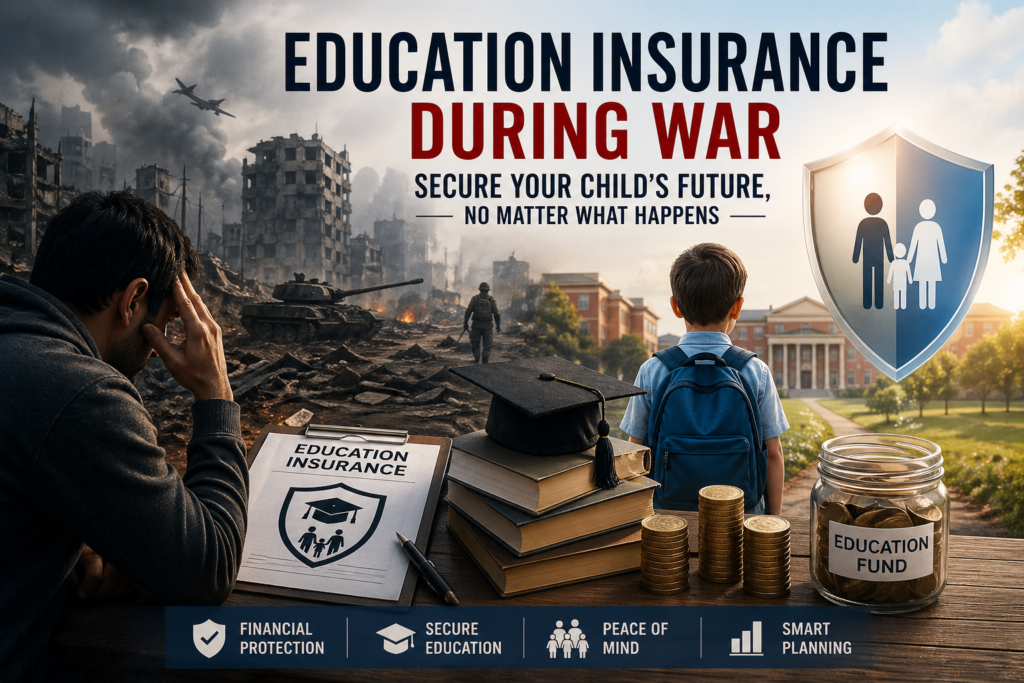
In times of peace, planning your child’s education is already a long-term financial commitment. But during war or conflict, that responsibility becomes even more serious. Uncertainty rises, incomes can become unstable, and access to quality education may suddenly be disrupted. For many families, what once felt like a manageable goal can quickly turn into a major concern.
War doesn’t just affect safety and daily life, it also impacts financial systems, job security, and future planning. Parents may face unexpected challenges such as loss of income, displacement, or rising education costs due to inflation and currency fluctuations. In such situations, having a solid financial backup for your child’s education is not just important, it becomes essential.
This is where education insurance comes into play. It is designed to protect your child’s academic future, even if something happens to you. However, during wartime, not all insurance policies function the same way. Certain conditions, exclusions, and risks can affect how and when benefits are paid.
The purpose of this guide is simple: to help you understand how education insurance works during war and how you can make smarter decisions to secure your child’s future despite uncertain conditions. With the right approach, planning, and awareness, you can still build a strong financial safety net, even in challenging times.
Table of Contents
What is Education Insurance?
Education insurance is a financial plan designed to ensure that your child’s education continues smoothly, even if something unexpected happens to you. It combines insurance protection with long-term savings, so you’re not just building a fund, you’re also securing it against risks.
In simple terms, you pay regular premiums over a period of time, and the policy builds a fund that can be used for your child’s future education expenses like school fees, college tuition, or even studying abroad.
How Education Insurance Works
The structure is quite straightforward:
- You choose a plan based on your child’s future education needs
- You pay premiums monthly or yearly
- The policy grows over time (either fixed or market-linked returns)
- At maturity, a lump sum or scheduled payouts are given for education
There’s also an important protection feature:
- If the parent (policyholder) passes away during the policy term,
- The insurance company pays an immediate amount
- Future premiums are usually waived
- The child still receives the full education benefit
This is what makes education insurance different from regular savings.
Types of Education Insurance Plans
There are a few common types you should know about:
1. Child Education Plans
These are specifically designed for children’s future needs.
- Provide payouts at key education milestones
- Include life cover for the parent
2. Endowment Plans
- Offer guaranteed returns after a fixed period
- Lower risk, but returns are usually moderate
- Suitable for conservative planning
3. ULIPs (Unit Linked Insurance Plans)
- Combine insurance with market investments
- Higher potential returns, but also higher risk
- Good for long-term goals if you can handle market fluctuations
Why Education Insurance Matters (Especially in Uncertain Times)
Education costs are rising every year, and during unstable conditions like war, inflation can make things even worse. A plan that seemed enough today might fall short tomorrow.
Education insurance helps you:
- Lock in a financial plan early
- Stay disciplined with savings
- Protect your child’s future even if you’re not around
- Reduce stress during uncertain situations
It acts as both a safety net and a goal-oriented investment, which is why many parents consider it an essential part of financial planning.
What Happens to Education Insurance During War?
This is the part many people overlook. Education insurance can protect your child’s future, but during war, its performance depends heavily on the terms written in the policy.
Not all situations are treated equally, especially when conflict is involved.
Understanding War Clauses in Insurance
Most insurance policies include something called a war exclusion clause. This clause defines how the policy will respond if death or loss happens due to war, invasion, civil unrest, or military action.
Here’s the key point:
- Many policies do not fully cover war-related risks
- Some may limit the payout
- Others may only return the premiums paid (without profit)
So if a policyholder dies due to war-related causes, the full education benefit might not always be paid.
Natural Death vs War-Related Death
Insurance companies usually make a clear distinction:
- Natural death or illness:
Full benefits are typically paid to the child - War-related death:
Coverage may be restricted depending on the policy terms
This difference is critical. Two similar situations can lead to very different financial outcomes.
Impact on Payouts and Claims
During war, even if your policy is valid, you may face:
- Delays in claim processing due to instability
- Additional documentation requirements
- Reduced payouts if exclusions apply
- In extreme cases, policy suspension or complications
This doesn’t mean education insurance becomes useless, but it does mean you need to understand its limits.
What About Premium Payments During War?
Another important concern is what happens if you can’t continue paying premiums:
- Some policies offer a grace period
- Others may convert into a paid-up policy (reduced benefits)
- If payments stop completely, the policy may lapse
This can directly affect the final education fund your child receives.
Why This Section Matters
The idea of education insurance is protection, but during war, that protection is not always absolute. The difference lies in the fine print.
That’s why it’s important to:
- Read your policy carefully
- Understand exclusions
- Plan additional financial backups
Key Risks Parents Face During War
War doesn’t just create safety concerns, it deeply affects financial stability and long-term planning. For parents trying to secure their child’s education, these risks can directly impact both savings and insurance outcomes.
Understanding these challenges helps you prepare better and avoid unpleasant surprises.
1. Loss of Income and Job Instability
One of the first impacts of war is economic disruption.
- Businesses may shut down or reduce operations
- Salaries can be delayed or reduced
- Job loss becomes more common
If your income becomes unstable, paying regular insurance premiums can become difficult. Missing payments can reduce benefits or even cause your policy to lapse.
2. Inflation and Rising Education Costs
War often leads to high inflation and currency devaluation.
- School and university fees can increase rapidly
- Cost of studying abroad may become unaffordable
- Daily living expenses also rise
This means the amount you planned years ago might not be enough to cover future education costs.
3. Disruption of Education Systems
In conflict situations:
- Schools and universities may close temporarily
- Students may need to relocate or switch institutions
- Online education may become the only option
This can lead to unexpected expenses and changes in your original education plan.
4. Financial System Instability
War can affect banks, investment markets, and even insurance companies.
- Delays in withdrawals or fund access
- Market-linked plans (like ULIPs) may lose value
- Insurance claim processing can slow down
In extreme cases, financial institutions may struggle to operate normally.
5. Risk of Displacement
Families may be forced to move due to safety concerns.
- Relocation costs can be high
- Access to financial documents may become difficult
- Education plans may need to be adjusted quickly
This adds another layer of uncertainty to long-term planning.
6. Limited Insurance Coverage in War Zones
As discussed earlier, not all policies fully cover war-related risks.
- Claims may be partially paid or denied
- Policy conditions may change depending on location
- Some insurers may stop offering services in high-risk areas
This makes it risky to depend on a single insurance plan.
Why These Risks Matter
Each of these factors can weaken your financial plan if you’re not prepared. Education insurance is helpful, but during war, it should be part of a broader strategy, not your only solution.
Being aware of these risks allows you to:
- Plan more realistically
- Build backup options
- Stay financially flexible
How to Choose the Right Education Insurance Plan in Uncertain Times
When conditions are stable, choosing an education insurance plan is mostly about returns and affordability. But during war or uncertainty, your priorities need to shift toward security, flexibility, and reliability.
A good plan is not just one that grows your money, it’s one that can withstand disruption.
1. Check for War Risk Coverage (If Available)
Start by carefully reviewing the policy terms.
- Look for any mention of war or conflict-related coverage
- Understand what is included and what is excluded
- Check if partial benefits are provided in such cases
Not all policies offer this, but knowing the limits helps you plan better.
2. Choose a Financially Strong Insurance Company
In uncertain times, the strength of the insurer matters a lot.
- Go with companies that have a strong financial background
- Look at their claim settlement ratio
- Check customer reviews and long-term performance
A reliable insurer is more likely to honor claims even during difficult situations.
3. Prefer Flexible Plans
Flexibility can make a big difference when your situation changes.
Look for features like:
- Premium payment flexibility (monthly, yearly, or adjustable)
- Grace periods for missed payments
- Partial withdrawals in emergencies
- Option to modify coverage if needed
This helps you stay on track even if your income becomes unstable.
4. Understand the Premium Waiver Benefit
This is one of the most important features in education insurance.
- If the policyholder dies, future premiums are waived
- The policy continues, and the child still receives full benefits
Make sure this benefit applies clearly and check if there are any exceptions during war.
5. Compare Fixed vs Market-Linked Plans
You’ll usually have two options:
- Fixed return plans (Endowment):
- Lower risk
- Stable but moderate returns
- Market-linked plans (ULIPs):
- Higher return potential
- More risk, especially during unstable periods
In uncertain times, many parents prefer a balanced approach or lower-risk options.
6. Read the Fine Print Carefully
This is where most people make mistakes.
- Go through terms and conditions in detail
- Pay attention to exclusions and limitations
- Understand claim procedures and required documents
Even a good plan can fail you if you don’t fully understand it.
7. Don’t Rely on One Plan Only
Education insurance is important, but it shouldn’t be your only strategy.
- Combine it with savings and other investments
- Keep an emergency fund
- Stay financially diversified
This reduces risk and gives you more control.
Final Thought for This Section
Choosing the right education insurance plan during war is less about chasing high returns and more about protecting stability. A well-chosen plan can act as a strong foundation, but only if it’s backed by smart decisions and careful planning.
Smart Strategies to Protect Your Child’s Education
Education insurance is helpful, but during war or uncertainty, relying on a single plan is risky. The smarter approach is to build a layered strategy that protects your child’s education from multiple angles.
Here’s how you can strengthen your financial planning.
1. Diversify Your Financial Planning
Don’t put all your money into one place.
Along with education insurance, consider:
- Savings accounts for short-term needs
- Gold or other stable assets
- Low-risk investment options
Diversification helps reduce the impact if one area is affected during instability.
2. Build a Strong Emergency Fund
An emergency fund is essential, especially in uncertain conditions.
- Aim to save at least 6–12 months of expenses
- Keep it in an easily accessible form (like a bank account)
- Use it only for real emergencies
This fund can help you continue your child’s education even if your income is disrupted.
3. Plan for International or Alternative Education Options
War can disrupt local education systems, so it’s wise to have backup options.
- Consider opportunities for studying abroad
- Look into online or distance learning programs
- Research countries offering student support or scholarships
Having alternatives gives your child more flexibility if local systems are affected.
4. Keep Important Documents Safe and Accessible
In unstable situations, access to documents can become difficult.
Make sure you:
- Store insurance policies, IDs, and financial records securely
- Keep digital copies in cloud storage or email
- Share access with a trusted family member
This ensures smooth claim processing or financial access when needed.
5. Review and Update Your Plan Regularly
Your financial situation and risks can change quickly during war.
- Review your insurance policy at least once a year
- Update beneficiaries if needed
- Adjust coverage based on rising education costs
Regular updates keep your plan relevant and effective.
6. Consider Partial Withdrawals or Flexible Options
Some insurance plans allow partial withdrawals.
- Use this feature carefully for urgent education needs
- Avoid withdrawing too early unless necessary
- Understand how it affects final benefits
Flexibility can be useful, but it should be managed wisely.
7. Stay Informed and Proactive
Conditions during war can change rapidly.
- Keep track of economic and financial updates
- Stay informed about insurance policy changes
- Be ready to adjust your strategy when needed
Being proactive gives you better control over uncertain situations.
Final Thought for This Section
Protecting your child’s education during war is not about one perfect solution. It’s about combining insurance, savings, and smart planning to create a system that can handle uncertainty.
The more flexible and diversified your approach, the more secure your child’s future will be.
Alternatives to Education Insurance During War
While education insurance is useful, it’s not always enough, especially in high-risk or conflict situations. That’s why it’s important to explore alternative options that can support your child’s education if insurance coverage falls short.
Having multiple paths ensures your child’s future doesn’t depend on just one system.
1. Scholarships and International Aid Programs
Many organizations and governments offer support to students affected by conflict.
- Merit-based and need-based scholarships
- Programs for students from war-affected regions
- International aid for education continuity
These opportunities can significantly reduce or even cover full education costs.
2. Education Savings Plans
Simple savings can sometimes be more reliable than complex policies.
- Regular deposits into a dedicated education fund
- No dependency on insurance terms or exclusions
- Full control over your money
Even small, consistent savings can grow into a strong financial backup over time.
3. Government Support and Relief Programs
During or after conflict, governments may introduce support systems.
- Financial aid for students
- Fee reductions or free education programs
- Emergency relief funds
Availability depends on the country, but it’s always worth staying informed.
4. Family and Community Support Systems
In many cases, extended family or community networks play a key role.
- Financial help from relatives
- Community-based education funds
- Support from local organizations
While not a primary plan, this can act as a safety net in difficult times.
5. Low-Risk Investment Options
If you prefer more control, consider safer investment avenues.
- Fixed deposits
- Government bonds
- Gold or other stable assets
These options may not offer very high returns, but they provide stability, which is crucial during uncertain periods.
6. Online and Flexible Learning Options
If traditional education is disrupted:
- Online courses and degree programs
- Remote learning platforms
- International virtual education systems
These alternatives can keep your child’s education on track even if physical institutions are affected.
Final Thought for This Section
Education insurance is just one piece of the puzzle. During war, the strongest approach is to combine it with practical alternatives and backup plans.
Flexibility is your biggest advantage. The more options you have, the better prepared you’ll be to handle unexpected challenges.
Real-Life Scenario (Example Section)
To understand how all of this works in real situations, let’s look at a simple example. This helps connect the theory of education insurance and planning with what actually happens during uncertain times.
Example: A Parent Planning During Uncertainty
Imagine a parent who starts an education insurance plan when their child is very young. At that time, everything is stable. The goal is simple: save steadily and secure funds for future school and university fees.
A few years later, the situation changes. Due to conflict in the region:
- The parent’s income becomes irregular
- Inflation increases education costs
- Schools in the area temporarily shut down
- Financial uncertainty grows
Now the original plan alone is not enough.
What Went Right in This Case
Because the parent planned early, some protection was already in place:
- The education insurance policy had already built value over time
- Life cover ensured the child would still receive benefits if anything happened to the parent
- A basic savings fund was also available for short-term needs
This combination provided stability during a difficult time.
What Challenges Still Appeared
Even with insurance in place, some problems came up:
- Premium payments became difficult during income disruption
- Education costs increased faster than expected
- Access to local schools became uncertain
This shows that insurance alone cannot handle every situation.
How the Situation Was Managed
The parent adjusted their strategy:
- Continued only essential premium payments
- Used emergency savings to cover education expenses temporarily
- Shifted the child to online learning for continuity
- Explored scholarship opportunities for future support
By combining different options, the child’s education did not stop completely.
Key Lesson from This Scenario
The most important takeaway is simple:
Education insurance helps create a foundation, but during war or crisis, flexibility and backup planning matter just as much.
No single financial product can fully protect against every risk. A mix of insurance, savings, and alternative education options creates a much stronger safety net.
Common Mistakes to Avoid
When it comes to education insurance during uncertain times like war, most problems don’t come from the situation itself, but from planning mistakes made early on. Avoiding these can make a huge difference in your child’s financial security.
1. Ignoring Policy Exclusions
One of the biggest mistakes is not reading what the policy actually covers.
- Many people assume everything is included
- War, civil unrest, or conflict-related events are often excluded
- This can lead to rejected or reduced claims later
Always check the exclusions section carefully before relying on any policy.
2. Relying Only on Education Insurance
Education insurance is helpful, but it should never be your only plan.
- It may not fully cover inflation or sudden cost increases
- It can be affected by war clauses or restrictions
- It may not provide immediate liquidity when needed
A strong plan always includes savings and backup options too.
3. Not Keeping Premium Payments Flexible
Some parents choose plans without considering future uncertainty.
- Fixed high premiums can become difficult during income loss
- Missing payments can reduce benefits or lapse the policy
- Flexibility is often more important than high returns
Choose a plan that you can continue even in difficult times.
4. Delaying Financial Planning
Waiting too long is another common mistake.
- Starting late means higher premiums
- Less time for your money to grow
- Reduced financial protection for your child
Early planning gives you more control and better outcomes.
5. Not Updating the Policy Over Time
Life situations change, but many people forget to update their plans.
- Beneficiaries may change
- Education costs increase over time
- Financial goals may shift
Regular reviews help keep your plan relevant.
6. Not Having Emergency Savings
Depending only on insurance is risky.
- Insurance is long-term, not immediate support
- Emergencies require quick access to funds
- Without savings, you may face financial pressure during crisis
An emergency fund is essential alongside insurance.
7. Ignoring Currency and Inflation Risks
In unstable times, money value can change quickly.
- Education costs may rise faster than expected
- Currency value may drop in conflict situations
- Fixed insurance payouts may lose real value
Planning for inflation helps protect long-term goals.
Final Thought for This Section
Most financial failures during crisis don’t happen because people had no plan, but because the plan was incomplete. Avoiding these mistakes helps you build a more realistic and reliable system for your child’s education.
Frequently Asked Questions (FAQs)
Here are some of the most common questions parents have about education insurance during war or uncertain conditions.
1. Does education insurance cover war-related death?
In most cases, no full coverage is provided for war-related deaths. Many insurance policies include a war exclusion clause, which means the insurer may:
- Deny the claim
- Offer a reduced payout
- Or return only the premiums paid (depending on the policy)
It completely depends on the terms of your specific insurance plan.
2. What happens to my education insurance if war starts in my country?
If war or conflict begins, your policy usually remains active, but:
- Claims may become more complicated
- Some benefits may be limited due to exclusions
- Processing delays can occur due to financial instability
The policy does not automatically cancel, but its benefits may be affected.
3. Can I stop paying premiums during war?
Yes, in many cases there are options, but consequences vary:
- Some policies offer a grace period for missed payments
- Some convert into a reduced “paid-up” policy
- If payments stop completely, the policy may lapse
It’s always better to check your insurer’s specific rules.
4. Is education insurance still useful during conflict situations?
Yes, but with limitations.
It still provides:
- Long-term savings for education
- Basic financial protection for your child
- Structured discipline for planning
However, it should be combined with savings and alternative plans for full security.
5. What is the safest alternative to education insurance during war?
There is no single “perfect” alternative, but safer options include:
- Personal savings funds
- Government bonds or fixed deposits
- Scholarships and education aid programs
- Diversified low-risk investments
A combination of these works best.
6. Can I withdraw money from education insurance early?
Some plans allow partial withdrawals, especially ULIPs or flexible policies.
But keep in mind:
- Early withdrawal may reduce final benefits
- Some policies have penalties
- It may affect your long-term education goal
Always check terms before withdrawing.
7. How can I make my child’s education more secure during uncertain times?
The best approach is a mix of strategies:
- Education insurance for structured savings
- Emergency fund for short-term needs
- Backup education options (online or abroad)
- Diversified financial planning
This combination offers stronger protection than relying on one option.
Conclusion
Planning for your child’s education is always important, but during war or uncertain times, it becomes even more critical. Conditions can change quickly, and financial stability is often the first thing to be affected. That’s why relying on a single plan is never enough.
Education insurance can still play a valuable role in your financial planning. It helps you build a structured fund for your child’s future and offers protection in case of unexpected events. However, as we’ve seen, it also has limitations, especially when it comes to war-related risks and exclusions.
The strongest approach is not just about choosing the right insurance plan, but about building a complete strategy. A combination of education insurance, emergency savings, alternative education options, and diversified financial planning gives you a much stronger safety net.
At the end of the day, the goal is simple: to ensure that your child’s education continues without interruption, no matter how uncertain the world becomes. With careful planning and regular review of your financial decisions, you can create stability even in unstable times.